10
Mar
In recent years, the discussion around data engineering has shifted from simply “moving data” to “securing and governing data at scale.” If your production pipelines are powered by AWS Glue 5.0, you are running on a reliable foundation, but you are missing out on the secure-by-default architecture offered by AWS Glue 5.1.
Since its general availability, AWS Glue 5.1 has redefined how write operations and open table formats (OTFs) are handled. If your team is debating this “minor” version bump, this guide breaks down why the transition to Glue 5.1 is a strategic benefit for high-velocity data teams for running production-ready secure data pipelines.
The most immediate technical benefit of Glue 5.1 is the upgrade of its foundational compute engine. While Glue 5.0 established the Spark 3.5 baseline, Glue 5.1 moves the needle to Apache Spark 3.5.6, bringing a suite of features and upgrades like:
In previous iterations, AWS Lake Formation provided robust Fine-Grained Access Control (FGAC) for read operations. However, managing write operations (DML and DDL) often required a fragmented mix of IAM policies and S3 bucket-level permissions.
AWS Glue 5.1 solves this by extending FGAC to write operations, thus providing:
INSERT, UPDATE, or DELETE records at the row and column level directly using Lake Formation.The adoption of Open Table Formats (OTF) is the standard for data lakes in the modern era. AWS Glue is built to support this shift with Glue 5.1 bringing native integrations for the latest versions of Apache Iceberg, Apache Hudi, and Delta Lake.
The support for Iceberg Format V3 is particularly noteworthy. It features default column values for more flexible schema evolution without breaking downstream consumers and row-lineage tracking that simplifies the audit trail for transactional data.
It also supports geospatial analytics by introducing geometry and geography native data types as first-class citizens for advanced location intelligence. Also, Deletion Vectors (DVs) replaces delete files with compact, highly efficient binary bitmaps that speeds up merge-on-read operations and reduces file layout fragmentation.
| Feature | Version in Glue 5.0 | Version in Glue 5.1 | Benefit and Impact |
|---|---|---|---|
| Apache Iceberg | Version 1.7.1 | Version 1.10.0 | Includes useful features as listed above from Iceberg Format V3 as well as Iceberg Materialized Views. |
| Apache Hudi | Version 0.15.0 | Version 1.0.2 | Enhances Full-Table Access (FTA) and metadata indexing for massive datasets. |
| Delta Lake | Version 3.3.0 | Version 3.3.2 | Provides deeper integration with the latest Spark engine features, Liquid Clustering and more. |
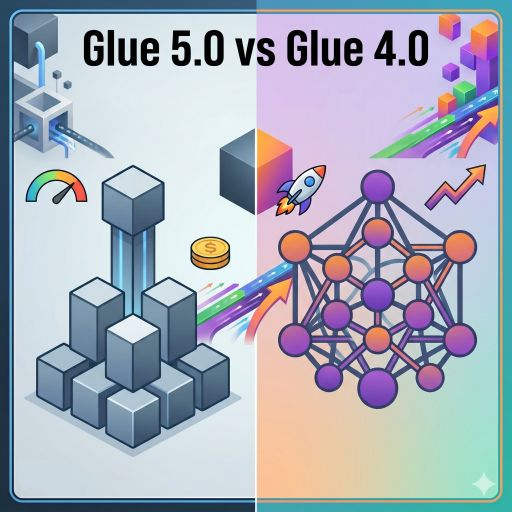
A side-by-side comparison between Glue 5.0 and 5.1 for your quick reference:
| Component | AWS Glue 5.0 | AWS Glue 5.1 |
|---|---|---|
| Spark Version | Spark 3.5.4 | Spark 3.5.6 |
| Python Version | Python 3.11 | Python 3.11 |
| S3 Connector | S3 (Legacy) | S3A (Default) |
| Write FGAC | Not Supported | Supported (Lake Formation) |
The migration from Glue 5.0 to 5.1 is designed to be a “drop-in” replacement for most workloads. However, there are minimum two specific factors you should account for during your migration to AWS Glue 5.1. Let’s check them in detail below:
Glue 5.1 now utilizes the optimised S3A connector by default (s3a://). This brings enhanced performance and aligns with the latest Amazon EMR optimizations. While this will help accelerate workloads, you should re-verify any custom performance-tuning flags in your Spark configuration that were specific to the older S3 connector.
GlueVersion parameter in your Job Details or CloudFormation templates to 5.1.StartJobRun parameters and Lake Formation write-support.Pro Tip: Start by migrating your Iceberg or Delta Lake jobs first to get the most benefits. The performance improvements from the updated OTF libraries often provide the most immediate ROI by lowering DPU hours (and thus costs).
If you stay with Glue 5.0 for your production pipelines, it is a safe choice for static, low-risk pipelines. However, if you are building a modern, transactional data lake, AWS Glue 5.1 is the new baseline. With the Spark 3.5.6 engine refinements, the critical Lake Formation write-governance and more, AWS Glue 5.1 provides the security and performance required for the next generation of data integration projects.
↫ Previous post
Get in touch to discuss an idea or project. We can work together to make it live! Or enquire about writing guest posts or speaking in meetups or workshops.

